Compiled by Sara Mae Berman, Orienteering USA Convention Committee chair (with thanks to Valerie Murray, whose "Guidelines ... on USOF Annual Convention" provided the basis for this report), August 2008.
Jump down to a list of Convention locations
Orienteering USA Bylaws provide for an annual general meeting (AGM), but holding an annual convention has been a practice since the early days of the federation — until 2001, when no club volunteered to host it. This break in tradition gives us a chance to re-examine why we hold conventions.
In the guidelines published by Valerie Murray, the purpose of a convention include:
- To conduct Orienteering USA's annual business: election of officers, meetings of the Board of Directors (BOD), committee meetings, bylaws changes, etc.
- To share information on all aspects of O, from all parts of our country
- To improve our sport, at both the club and individual level, through educational workshops
- To hold a training camp to encourage juniors
- To enjoy our sport in its various forms as fun events
To the above, I would add the following new ideas:
- A SKILLS IMPROVEMENT TRAINING CAMP and a MAPPING TRAINING CAMP held in alternate years. Each would be conducted for a few hours each day for 3 days of the convention. This would provide continuity of learning, while allowing the attendees to go to some other workshops and activities as well. I see these being conducted by or at least guided by the efforts of someone like Bill Shannon, who (urged by Orienteering USA) held both kinds of training for about a decade with a small fee charged participants. He didn't go it alone, but hired top-notch orienteers to work with the more advanced people, while he usually worked with lesser skilled people, giving them the right start. I think he and any team members who did this at a convention should receive a stipend; that those who take part should expect to pay a small surcharge, over and above the convention fee, and Orienteering USA could share the costs as part of its promotion efforts.
- A BENEFIT FROM Orienteering USA to each host club would be a MAP OF A LOCAL PARK, good for Park-O and other promotions. A mapper, paid by Orienteering USA, could make that map, and/or an "expert" could come to the club ahead of time (even the previous year) and teach interested club members how to map, the result being the Park map and some people with mapping experience.
ORIENTEERING USA CONVENTION GUIDELINES, THE BASICS
WHY SHOULD YOUR CLUB BE A HOST?
A convention has to be fun as well as educational for your club members. It will involve newer as well as longer-term club members, because so many of the tasks at a convention don't require technical expertise in O; it will allow local club members, especially those who don't travel to away meets, to get to know O-ers from around the country.
A convention can serve as a development tool by the host club: to get itself better known in the community, by citizens, by local business, by youth or Scout groups, by education groups who could use O as a teaching resource.
Where you live is special to you for many reasons: holding a convention allows you to show off your area's special attractions. Therefore, a convention consists of:
- the arrangements,
- the activities, and often
- an A meet.
First, let's consider the components of a convention.
PART I – THE ARRANGEMENTS
- HOSTS: O-clubs host conventions, and it is they who bring their bid (consisting of an outline of their accommodation arrangements and O-activities) to the BOD. The club is the recognized agent of the federation, under whose legal and liability protection they operate. One person cannot do it all! (What if he/she gets sick?) A group of six has been found to be an optimum number to cover the responsibilities and provide a sounding board to each other as the convention and its activities are planned. They should live near each other or be able to hold remote conferences easily. Of course, these "chiefs" will need an army of volunteers to carry out the details.
- SITE: A place where people can stay (dormitory-style), eat together (in a cafeteria), and have space for workshops (classrooms, lecture halls, outdoor park areas, athletic facilities) and the AGM—all near each other. It will have a central location, with a club member on duty, where people go to check in, get information and the activities schedule or any changes/additions, and have their problems solved — and meet friends. Colleges, private schools, camps, environmental centers, etc., can provide the low-cost accommodations which will encourage attendees to stay together there — and mix-and-mingle. Local motels: If a college, camp, or other single institution is not available, then local motels/hotels must be available: probably this means that the host club will have to reserve blocks of rooms (usually at a discount, available until a specified date). Then, meeting rooms, eating arrangements, etc., have to be separately organized. (This is really less desirable since it means people will be scattered around and reduces the time and opportunity for personal contact.)
- FOOD: an all-important item. If food service is part of the accommodations, the host club must make sure that the food provider understands how large O-appetites are! O-ers tend toward a very healthy diet, less fat, more carbohydrates, some vegetarian alternatives and, of course, second helpings on bread, salad, etc.; O-ers, prefer to serve themselves, so buffet-style meals are best. O-ers can forgive a lot, but not poor food arrangements.
- LOCATION: Desirable, but not required, is that the convention center be near good transportation (e.g. good bus or train service, not too far from an airport), if you want to attract people from far away. While a remote location may seem romantic, having a town nearby will allow people (e.g. juniors) to use stores, pizza parlors, and other local amenities. O-MAPS of the local park or campus must be made for convention O-activities and workshops if not available already or must be fairly near.
- MONEY: The convention is not intended to make money, but going into debt can be avoided by careful, realistic planning. Renting facilities, arranging for meals, any costs associated with transportation, the junior camp, childcare, outside speakers, materials for activities, socials, etc., must be planned for. Attendees expect to pay a fee for the convention in addition to fees for the O-events. Fees must cover costs, while not being too high (to scare people away).
- INFORMATION: The host must publish the announcement of its convention and all attendant information, dates, etc., well in advance on the host club's website and newsletter, in the federation publication, on the O-net and, if possible, with an invitation to each club. Eight to nine months ahead of the convention dates is desirable (so people can plan their vacation dates). Several articles in the federation magazine and an up-dated website are desirable.
- SITE INFORMATION: The announcement must include: a map to the location and a map of the local facilities; details and costs of the accommodations, eating, childcare, and facilities available for attendees' use (e.g. college swimming pool); any local restrictions (e.g., no alcohol). Road signs to the convention site and to O-event sites make attendees feel welcome and preclude anyone getting lost on the way.
- CONVENTION PROGRAM: A booklet or sheets of information with the schedule of convention activities, a map of convention facilities and the local area, a list of the local conveniences (stores, restaurants, movies) and the nearby sights or areas of tourist interest. Often a club will include some history of the local area. Many clubs use this booklet to get ads from local businesses, which promote the local economy and make the club and our sport better known. If the convention host is organizing the A meet, this booklet can also include the necessary A-meet information. Convention (and A meet) registration form: you don't have to "reinvent the wheel"; look at forms from previous years; the Orienteering USA Convention Committee chairman can help you.
- MEDICAL CONCERNS: Know where the nearest hospital and emergency service is. Make sure they will provide walk-in service. This should be listed in the program.
- CHILDCARE: A must for youngsters under 5 or 6, because conventions need to attract families. It must be planned well ahead and be in a proper location with appropriate supervision. Definite limits to the time for this service should be set and understood by the parents and the caregivers. Parents do expect to pay a reasonable fee for this service. Parents usually want to eat with their own children, so meals may not be included, but this can be planned ahead of time.
- KIDDIE CAMP: This has been done at some conventions for the 6-12 age range. Often this is a set of indoor and outdoor games and O-fun for several hours a day, but not the whole day. Indoor space must be arranged in case of rain. Arrangements for Kiddie Kamp differ depending on the club members and facilities available. If this is not arranged, then the younger end of this age group will probably be in childcare. Some times fees are charged for this service, sometimes not.
- JUNIOR TRAINING CAMP: This has been a tradition since 1985 and is usually organized by the Junior Team officials. It is a wonderful opportunity for the 12-20 set from all over the country to meet and to train and socialize with each other. This group needs access to local O-maps — and the local pizza place. They often arrange some fund-raising activity. The Junior Team officials often get elite runners or US Team members to help coach the juniors. Sometimes, some activities can include the older Kiddie Kampers, at the option of the Junior leaders.
- TIME OF YEAR: Annual conventions have usually been held in the summer, late June to August, because that is when most people take vacations. But several years ago the BOD decided that its convention could be held at any time of year. This would allow those parts of the country (like the South), where summer is really very hot, to choose another, more friendly season. (In 1983, Vulcan OC of Birmingham, AL, hosted the convention in early March—when it was not warm enough for the local snakes to greet the O-ers.)
- VENDORS: For the past several conventions, a few vendors have been present at the convention, not just at the A meet. A secure space at the convention center is desirable, if possible. Make sure that this is permitted by the institution where the convention is located.
WHEW! WHAT A LOT TO CONSIDER...
Yes, but when people come from a long way and spend their precious vacation time and money, the host must try to provide the best experience possible. The Orienteering USA Convention Committee chairman is there to help, and s/he can refer you to experienced people from clubs which have already hosted a convention. Often the Convention Committee chairman will be able to help with getting leaders for technical workshops.
PART II – THE ACTIVITIES
- CONVENTION ACTIVITIES: Orienteering USA business gets conducted at a convention, committee meetings, forums on issues, the AGM, elections of officers, etc. Classrooms will do for most of these, but the AGM needs a large hall. The Convention chairman will act as a liaison with the host club to arrange what Orienteering USA needs to do its business. But the heart of the convention for most attendees consists of its workshops, O-activities, and social events.
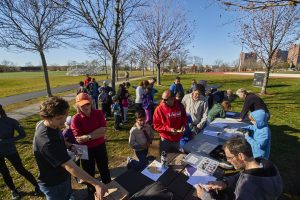
- WORKSHOPS (possibilities): Workshops and clinics on topics which interest many O-ers are led by local experts or people with particular skills. Here are some suggestions:
- Helping clubs attract/retain more members, promote O in its community, and hold better O-events, A meets, hold club training, club camping weekends, etc.
- How to use the new technologies, from data entry for O-events, to GIS, to OCAD for making maps; how to work with the electronic punching equipment
- Technical know-how: mapping, course-setting, meet administration
- How to conduct Trail-O, or other forms of O
- Injuries: prevention, possible treatment, related physical training; and other medical concerns, such as poison ivy/oak, Lyme disease, etc.
- Promotional activities: PR for clubs, O-events
- Search and rescue plans, problems, requirements
- Orienteering USA certification in coaching, event control, course consulting, etc.
- Educational certification possibilities for teachers, youth workers, etc., coordinated with the local college or other local entity
- Miscellaneous:
- the corporate connection—how to get paid teaching orienteering to corporations as team-building
- how to get tax exempt status for your club
- physical therapy
- finance for orienteers; nutrition for orienteers
- local resources may suggest more possibilities
- SOCIALIZING (possibilities): Social events allow people to meet old friends and make new ones. They provide the memories which keep people coming back to conventions.
- Wine (or other beverage) and cheese party
- Ice cream social (often sponsored by O/NA) with donations accepted for one or more of the national teams, usually held one or two nights before the A meet to attract the most people
- Swim party, volleyball game, etc.
- Ice-breaker games (match little-known facts about people with the actual person, etc.)
- Dinner to celebrate the week's activities with dancing or square dancing or some other kind of fun
- Music: live (members who play) or records
- Group tourist activities; your state and/or local tourist agency can provide information and booklets about local sights
- Silent auction as a fund-raiser for teams
- O-bingo, a fund-raiser for the junior teams
- PHYSICAL ACTIVITIES (Possibilities): Some traditional activities from past conventions —
- two-mile fun run; mountain trail run, etc.
- motala relay
- night O
- trail O
- other kinds of fun O (e.g. Canoe O, Vampire O, bike O, street O, trivia O, etc.)
- NEW IDEAS: Attracting new people is always a challenge. While all the suggestions mentioned above may sound interesting, two things seem to be foremost:
- improving one's O-skills
- learning and improving one's mapping skills
I would like to see a skills improvement training camp and a mapping training camp held in alternate years. I would like to see a Orienteering USA benefit to each host club be a map of a local park, good for Park O and other promotions.
PART III – THE A MEET
Because our country is so spread out, Orienteering USA has traditionally had an A meet with its annual convention. Sometimes the convention host club also holds the A meet; sometimes, several clubs combine efforts to hold the convention and A meet, splitting the duties among them. The form for convention registration and meet registration can be combined and, with the proper computer software, provide the information necessary to both those in charge of the convention and those holding the A meet. If a new map is needed for the A meet to go with the convention, your club can apply to Orienteering USA for funding. Naturally, all the Orienteering USA requirements for A meets apply, but it is important to remember that the convention should not be subordinated to the A meet. That is, the A meet should not take up most of the effort and people and resources available. The convention, its business, its education, and getting people from around our country together remains its main reason for being.
ORIENTEERING USA CONVENTION LOCATIONS |
| Year | Club/s | Convention/AGM Site | Location |
| 2015 | | | |
| 2014 | | | |
2013 Jul. 25 - Jul. 29 | BAOC | Sierra Summerfest AGM - July 27 | Truckee, CA |
2012 Sept. 1 | LROC RMOC | Laramie Historic Railroad Depot Laramie Daze 2012 - LROC 2012 Western States Orienteering Championships - RMOC | Laramie, WY |
2011 Jul. 31 - Aug. 5 | ROC | Cornell University Cooperative Extension AGM - August 4 2011 Convention Web Site 2011 Canal Cities Orienteering Festival | Rochester, NY |
2010 Jun. 27 - Jun. 30 | EWOC | Gonzaga University AGM - June 28 | Spokane, WA |
2009 Jun. 27 | COC | Senior Center 2009 Convention Web Site | Cle Elum, WA |
2008 Aug. 9 | LROC | Hilton Garden Inn University of Wyoming Conference Center | Laramie, WY |
2007 Aug. 3 - Aug. 12 | RMOC | Peaceful Valley BSA Ranch AGM - August 10, Templed Hills Camp and Retreat Center | Elbert, CO Woodland Park, CO |
2006 Aug. 18 | RMOC | Buena Vista Community Center | Buena Vista, CO |
2005 Aug. 26 - Aug. 27 | CROC | Central Oregon Community College | Bend, OR |
2004 Jun. 26 - Jul. 4 | GAOC COK | Truett-McConnell College AGM - July 2 2004 Convention Web Site | Cleveland, GA |
2003 Aug. 9 - Aug. 14 | UNO | Boston University's Sargent Center AGM - August 13 | Hancock, NH |
2002 Sept. 21 | GMOC | Beaver Brook Farm | Marshfield, VT |
2001 Jun. 24 | CROC | Double Creek Camp | Easton, WA |
2000 Jul. 29 - Aug. 6 | BAOC | Northstar-at-Tahoe Resort AGM - August 4 2000 Convention Web Site | Truckee, CA |
1999 Jun. 26 - Jul. 2 | DVOA | The School at Church Farm AGM - July 2 | Exton, PA |
1998 Jun. 22 - Jun. 25 | MVOC | Miami University AGM - June 25 | Oxford, OH |
1997 Aug. 23 - Aug. 26 | COC | Camp Waskowitz AGM - August 24 | North Bend, WA |
1996 Aug. 19 - Aug. 23 | NEOC | Camp Smith AGM - August 23 | Peekskill, NY |
1995 Jun. 24 - Jul. 2 | RMOC | Lake George Pavilion AGM - June 30, Grange Hall | Lake George, CO Florissant, CO |
1994 Aug. 14 - Aug. 19 | ROC/ BFLO | Cedar Glen Convention Centre AGM - August 19 | Bolton, ON, Canada |
1993 Jul. 14 - Jul. 18 | BAOC | Sugar Bowl Ski Lodge AGM - July 16 | Donner Summit, CA |
1992 Jul. 15 - Jul. 17 | COC | University of Washington AGM - July 15&17 | Seattle, WA |
1991 Jun. 26 - Jun. 28 | DVOA | West Chester University AGM - June 28 | West Chester, PA |
1990 Jun. 27 - Jun. 29 | WCOC | Kent School AGM - June 29 | Kent, CT |
1989 Jun. 28 - Jun. 30 | RMOC | Colorado School for the Deaf and Blind AGM - June 30 | Colorado Springs, CO |
1988 Jun. 22 - Jun. 24 | NEOC | Hampshire College AGM - June 24 | Amherst, MA |
1987 Jun. 24 - Jun. 26 | SDO | Point Loma Nazarene College AGM - June 26 | San Diego, CA |
1986 Jun. 16 - Jun. 21 | MNOC | Lakewoods Lodge, Telemark Ski Resort AGM - June 19 | Cable, WI |
1985 Jun. 25 - Jun. 28 | CSU | Plymouth State College AGM - June 29 | Plymouth, NH |
1984 Jun. 2 | QOC | Pennsylvania State University | Mont Alto, PA |
1983 Mar. 12 | VOC | Oak Mountain State Park | Birmingham, AL |
1982 Jun. 5 | ROSE | Rose-Hulman Institute of Technology | Terre Haute, IN |
1981 Jun. 6 | IUPOC | Indiana University of Pennsylvania | Indiana, PA |
1980 Apr. 12 | HVO | Sharpe Reservation Outdoor Education Center | Fishkill, NY |
1979 Aug. 15 | | Lake Superior State College | Sault Ste. Marie, MI |
1978 Apr. 9 | | Touch of Nature Center | Carbondale, IL |
1977 Oct. 15 | | A second general membership meeting to amend articles of incorporation was held at the USOF Office. | Athens, OH |
1977 Jun. 26 | | Western Michigan University | Kalamazoo, MI |
1976 Mar. 20 | USMA | U.S. Military Academy | West Point, NY |
1975 Feb. 22 | | Southern Illinois University | Carbondale, IL |
1974 Mar. 22 | | Ohio University | Athens, OH |
1973 Mar. 31 | | Tarhollow State Park | Chillicothe, OH |
1972 Apr. 19 | QOC | Marine Corps Base | Quantico, VA |
1971 Aug. 1 | | 933 North Kenmore Street (organizational meeting) | Arlington, VA |
| Contact: Robert Buraczynski (rburaczynski [at] localnet [dot] com) | last updated 28 February 2013 |